
Introduction
Rear projection film vs. traditional screens is an important comparison for businesses planning a commercial display project. Many buyers start by assuming they need a standard TV, commercial monitor, LED video wall, or printed sign. However, in many glass-heavy spaces, rear projection film can create a cleaner, more architectural, and more memorable display experience.
Rear projection film allows businesses to turn glass, acrylic, or Plexiglas into a digital display surface. A projector sits behind the glass and projects the image onto the film. Viewers see the content from the front side. As a result, the display feels integrated into the space instead of added onto the wall.
Traditional screens still have value. Commercial monitors, LCD displays, LED video walls, and digital signage screens work well for many applications. However, they do not always fit the visual goal. A standard screen may look bulky in a luxury lobby. A wall-mounted TV may not feel premium in a retail storefront. A monitor may block sightlines inside a museum, office, showroom, or trade show booth.
Therefore, businesses should compare both options before choosing a display system.
RearProjectionFilms.com helps commercial buyers understand how rear projection film works, where it performs best, and when it makes sense compared with traditional display screens. Screen Solutions International also supports commercial display projects through SSIDisplays.com, including rear projection films, digital signage, LED video walls, transparent OLED displays, projection systems, anti-glare film, and custom experiential displays.
If your business wants a display that feels less like a screen and more like part of the environment, rear projection film may be the better option.
What Is Rear Projection Film?
Rear projection film is a specialty film applied to glass, acrylic, or Plexiglas. Once installed, the film turns that surface into a projection display. A projector sits behind the glass and sends content onto the film. Customers, visitors, guests, or employees view the image from the front.
This creates a sleek display effect because the glass becomes the screen.
Businesses can use rear projection film for:
- Storefront window displays
- Corporate lobby features
- Museum exhibits
- Hotel glass walls
- Trade show booth panels
- Car dealership showrooms
- Restaurant partitions
- Healthcare waiting rooms
- Interactive glass displays
- Event displays
- Product launches
- Digital art installations
In addition, rear projection film can help businesses use existing architectural glass more effectively. Instead of adding another screen, the business can turn the surface it already has into a digital communication tool.
What Are Traditional Commercial Screens?
Traditional commercial screens include standard display hardware such as LCD monitors, LED displays, commercial TVs, video walls, menu boards, and touchscreen kiosks. These systems display content directly from the screen itself instead of relying on a projector and projection film.
Traditional screens are common because they are familiar, easy to specify, and widely used. They can work well for menus, directories, meeting rooms, retail displays, conference spaces, and public information screens.
However, traditional screens also have limitations. They often look like hardware, may interrupt design flow and can feel generic in premium environments. Additionally, they may not integrate naturally into glass walls, storefronts, partitions, or custom architectural features.
That is where rear projection film creates a different kind of value.
Rear Projection Film vs. Traditional Screens: Quick Comparison
| Feature | Rear Projection Film | Traditional Screens |
|---|---|---|
| Display Surface | Glass, acrylic, or Plexiglas | Built-in display panel |
| Visual Style | Architectural, integrated, futuristic | Familiar screen-based appearance |
| Best Use | Glass displays, windows, lobbies, exhibits, showrooms | Menus, directories, standard signage, meeting rooms |
| Hardware Visibility | Projector can be hidden behind surface | Screen hardware remains visible |
| Content Flexibility | Digital content updates through projector/media source | Digital content updates through media player/CMS |
| Space Impact | Uses existing glass surfaces | Requires wall, mount, stand, or structure |
| Design Appeal | Premium and unique | Practical and familiar |
| Interactivity | Possible with touch/sensor add-ons | Common with touchscreen displays |
| Brightness Planning | Requires projector and lighting review | Depends on screen brightness rating |
| Best Buyer Fit | Businesses wanting architectural impact | Businesses wanting standard signage reliability |
Both options can work well. However, the best choice depends on the project goal.
When Rear Projection Film Is the Better Choice
Rear projection film is often the better choice when the display needs to feel integrated, premium, or unexpected.
When You Want to Use Existing Glass
Many commercial spaces already include large glass surfaces. Retail storefronts, office lobbies, museum exhibits, hotel partitions, restaurant dividers, and showroom windows all offer display potential.
Instead of adding hardware, rear projection film lets businesses use that glass as the media surface. Therefore, the display can feel like part of the design.
When You Want a Cleaner Customer-Facing Side
Rear projection film places the projector behind the viewing surface. As a result, the customer-facing side can remain clean and minimal.
This works well in public areas where visible hardware may look cluttered or interfere with the experience.
When You Want a Premium Visual Effect
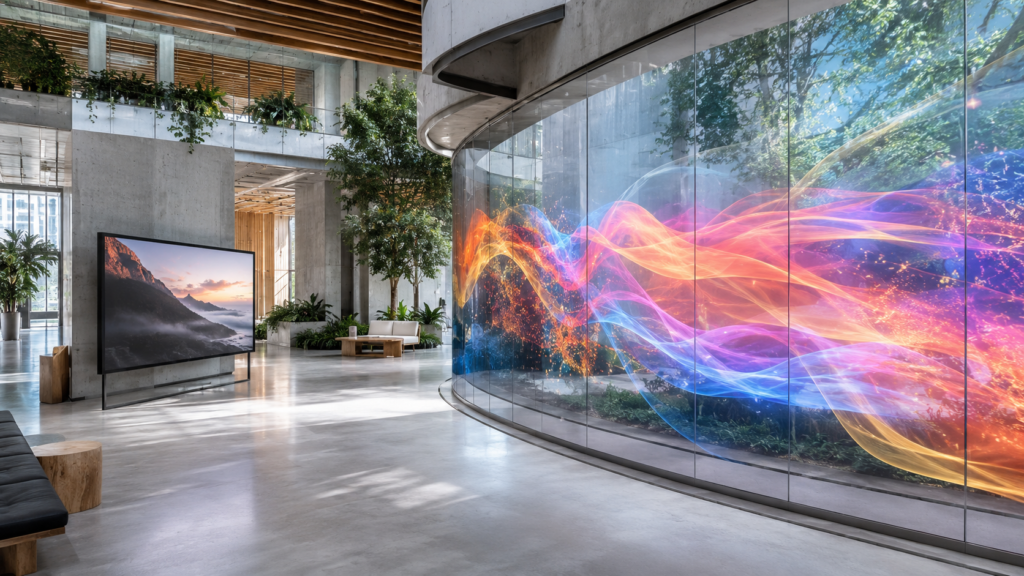
Rear projection film can create a high-end glass display effect. Depending on the film and content, the result can look futuristic, elegant, transparent, frosted, or holographic-style.
That effect can help attract attention in competitive commercial environments.
When You Need a Custom Size or Shape
Traditional screens come in fixed sizes. Rear projection film can be applied to custom glass or acrylic surfaces, depending on the project. This gives designers more flexibility for unique installations.
When You Want the Display to Feel Less Like a TV
In many premium environments, a standard TV may feel too basic. Rear projection film helps the display feel more intentional and experiential.
This matters in luxury retail, hospitality, corporate offices, museums, automotive showrooms, and trade show booths.
When Traditional Screens Are the Better Choice
Rear projection film is powerful, but it is not always the best answer. Traditional commercial screens may be better when the project needs simplicity, predictable brightness, or standard installation.
When You Need a Simple Wall-Mounted Display
For basic menu boards, meeting room screens, directories, and internal announcements, a commercial monitor may be the most direct solution.
When You Do Not Have Projector Space
Rear projection film needs room behind the glass for a projector. If the space cannot support projector placement, a traditional screen may be easier.
When Brightness Must Be Very High
Some environments need extremely bright displays. In those cases, high-bright commercial screens or LED video walls may perform better than projection film.
When You Need a Standard Touchscreen
Although rear projection film can support interactivity, traditional touchscreens are often simpler for basic kiosk applications.
When Installation Time Is Limited
A standard screen can sometimes install faster than a custom projection film system. Therefore, timelines may influence the decision.
Design Impact: Why Rear Projection Film Feels More Premium
Design matters in commercial spaces. A display should not only communicate information. It should also support the brand.
Rear projection film often feels more premium because it uses glass as the visual surface. Glass already communicates cleanliness, openness, and modern design. When digital content appears on that surface, the display can feel more integrated than a traditional monitor.
For example, a corporate lobby can use rear projection film on a glass wall to show brand visuals. A museum can use film on acrylic panels to layer digital storytelling into an exhibit. A car dealership can use showroom glass to display vehicle launch footage. A hotel can turn lobby glass into an elegant guest welcome feature.
In each case, the display becomes part of the architecture.
Traditional screens can also look polished, especially when recessed, framed, or built into a video wall. However, they still read visually as screens. Rear projection film creates a different impression because the display feels embedded into the environment.
Customer Experience: Which Option Attracts More Attention?
The answer depends on the environment, content, and display design. However, rear projection film often attracts attention because it is less expected.
People see standard screens everywhere. They see them in stores, airports, restaurants, offices, and waiting rooms. As a result, a normal screen may blend into the background.
Rear projection film can create more curiosity because the image appears on glass. This effect can encourage people to pause, look closer, and engage with the space.
That attention can support:
- More storefront visibility
- Stronger booth traffic
- Better exhibit engagement
- Higher lobby impact
- More memorable product launches
- Stronger brand perception
- Better event atmosphere
However, content still matters. A rear projection film display with weak content will not outperform a traditional screen with excellent content. Therefore, businesses should plan the display surface and the creative strategy together.
Installation Planning: What Buyers Need to Know
Rear projection film installations require thoughtful planning. The final result depends on the film, projector, lighting, glass, content, and viewing path.
Important planning factors include:
- Glass or acrylic size
- Film type
- Projector brightness
- Projector throw distance
- Ambient light levels
- Projector placement
- Viewing angles
- Content resolution
- Cable routing
- Equipment ventilation
- Cleaning access
- Anti-glare needs
- Installation timeline
- Maintenance access
Traditional screens also need planning, but the process may feel more familiar. Buyers usually review screen size, brightness, mounting, power, signal, media player, and content management.
In short, rear projection film offers more design flexibility, while traditional screens often offer more standardized deployment.
Content Strategy: Different Surfaces Need Different Creative
Rear projection film and traditional screens may use the same media files in some cases. However, the best content strategy differs.
Rear Projection Film Content
Rear projection film usually works best with:
- High-contrast visuals
- Large graphics
- Short messaging
- Motion loops
- Clean animation
- Simple product visuals
- Minimal text
- Strong focal points
- Content designed for glass
- Visuals that work from a distance
Because the image appears on glass, cluttered content can reduce impact. Therefore, simple and cinematic content usually performs better.
Traditional Screen Content
Traditional screens can handle more detailed information. For example, digital menu boards, directories, and presentation screens often include more text and structured layouts.
Traditional screens work well for:
- Menus
- Schedules
- Directories
- Dashboards
- Presentations
- Product catalogs
- Video playback
- Waiting room content
- Internal announcements
- Interactive forms
Therefore, content should match the display type.
Cost and ROI Considerations
Businesses should not compare rear projection film and traditional screens only by upfront product cost. The better question is: which option supports the goal more effectively?
Rear projection film can create ROI by making existing glass more valuable. A storefront window can become an advertising display. A lobby glass wall can become a branding feature. A trade show acrylic panel can become a booth attraction. A museum exhibit surface can become an educational media layer.
Traditional screens can create ROI through reliability, familiarity, and direct communication. A menu board can improve ordering speed. A directory can reduce visitor confusion. A meeting room screen can support presentations. A touchscreen kiosk can support self-service.
The best choice depends on what the display needs to accomplish.
Ask these ROI questions:
- Does the display need to attract attention?
- Does it need to fit into glass architecture?
- Does it need to support frequent updates?
- Does it need to communicate detailed information?
- Does it need to feel premium?
- Does it need to work in bright lighting?
- Does it need to be interactive?
- Does it need to support a measurable sales or service goal?
Once the business goal is clear, the technology decision becomes easier.
Best Commercial Uses for Rear Projection Film
Rear projection film works especially well in spaces where glass already plays a major design role.
Strong use cases include:
- Retail window displays
- Luxury storefronts
- Corporate lobby branding
- Museum storytelling panels
- Trade show booth glass
- Hotel lobby walls
- Restaurant private dining partitions
- Car dealership showroom glass
- Healthcare waiting room displays
- Interactive glass experiences
- Product launch environments
- Event sponsor displays
- Visitor welcome displays
In these environments, rear projection film can feel more custom and memorable than a traditional screen.
Best Commercial Uses for Traditional Screens
Traditional screens work best when businesses need direct, practical, and familiar visual communication.
Strong use cases include:
- Digital menu boards
- Conference room displays
- Employee communication screens
- Waiting room screens
- Wall-mounted directories
- Retail aisle screens
- Transportation information displays
- Quick-service restaurant menus
- Control room monitors
- Standard touchscreen kiosks
- Training room displays
- Presentation displays
In these environments, traditional screens often provide the most straightforward solution.
Can Businesses Use Both?
Yes. In many cases, the best commercial display strategy uses both rear projection film and traditional screens.
For example, a retail store can use rear projection film in the front window and standard digital signage inside the store. A hotel can use rear projection film in the lobby and traditional screens for event directories. A car dealership can use rear projection film on showroom glass and standard screens in the service waiting room. A museum can use rear projection film for immersive exhibits and traditional screens for detailed video stations.
This hybrid approach gives each display type a clear role.
Rear projection film creates visual impact. Traditional screens handle practical communication. Together, they can create a stronger customer experience.
Common Mistakes Buyers Should Avoid
Choosing a Traditional Screen When Glass Could Do More
If the space already has strong glass architecture, rear projection film may create a more integrated display experience.
Choosing Rear Projection Film Without Projector Planning
Rear projection film requires projector placement, brightness planning, and alignment. Skipping this step can reduce performance.
Ignoring Lighting Conditions
Both traditional screens and rear projection film need lighting review. Bright environments can create glare, washout, and readability problems.
Using the Same Content Everywhere
Content should match the display type. Rear projection film needs bolder visuals, while traditional screens can handle more detailed information.
Forgetting the Brand Experience
A display should fit the brand. A premium environment may need a more architectural solution than a standard screen.
Future Trends in Commercial Display Design
Commercial display design is moving toward more integrated and experience-driven systems.
First, businesses will continue turning glass into active media surfaces. Rear projection film fits this trend because it makes windows, partitions, and acrylic panels more useful.
Second, hybrid display ecosystems will become more common. Companies will combine rear projection film, digital signage, LED video walls, transparent OLED, interactive kiosks, and anti-glare film to solve different communication needs.
Third, content will become more location-specific. Instead of using one generic loop everywhere, businesses will create content for each display surface and audience.
Fourth, interactive glass will grow. Rear projection film can pair with touch overlays, sensors, RFID, NFC, cameras, and mobile triggers to create more engaging experiences.
Finally, ROI will matter more. Buyers will want displays that improve attention, communication, customer experience, and brand perception.
FAQ
Is rear projection film better than a traditional screen?
Rear projection film is better when a business wants to turn glass into a premium digital display surface. Traditional screens are better for standard signage, menus, directories, and simple wall-mounted displays.
Does rear projection film need a projector?
Yes. Rear projection film needs a projector behind the surface. The projector sends content onto the film so viewers can see the image from the front.
Can rear projection film replace digital signage?
It can replace digital signage in some glass-based applications. However, many businesses use rear projection film and traditional digital signage together.
Is rear projection film good for storefront windows?
Yes. Rear projection film can work well for storefront windows, especially when businesses want a dynamic glass display. Lighting, projector brightness, and glare control should be reviewed first.
Which is more flexible: rear projection film or traditional screens?
Rear projection film can be more flexible for custom glass surfaces and architectural displays. Traditional screens are often more flexible for standard content management and quick installations.
Why Choose Screen Solutions International
Screen Solutions International helps businesses compare rear projection film, traditional screens, transparent displays, digital signage, LED video walls, interactive kiosks, anti-glare film, and custom experiential displays. This matters because every commercial space is different.
Some projects need a clean rear projection film display on glass. Others need a standard commercial screen. Many need both. SSI can help buyers choose the right technology mix based on the environment, audience, budget, content, and business goal.
For rear projection education and ideas, visit RearProjectionFilms.com. For commercial display products and project support, visit SSIDisplays.com. To discuss a display project, call 888-631-5880.
Final Takeaway
Rear projection film vs. traditional screens is not a one-size-fits-all decision. Traditional screens work well for practical digital signage, menus, directories, presentations, and standard communication. Rear projection film works best when businesses want to turn glass into a premium digital display surface.
In summary, rear projection film offers a more architectural and memorable experience. Traditional screens offer a familiar and practical display format. The best choice depends on the space, lighting, audience, content, and business goal.
To explore rear projection film options for your commercial space, visit RearProjectionFilms.com or call Screen Solutions International at 888-631-5880.
Sources
Internal SSI Links
- SSIDisplays.com
- Rear Projection Films
- Projection Film Options
- Definition Rear Projection Film
- Accent Rear Projection Film
- Intrigue Rear Projection Film
- Rear Projection Film Samples
- Transparent OLED Displays
- Anti-Glare Film