
Introduction
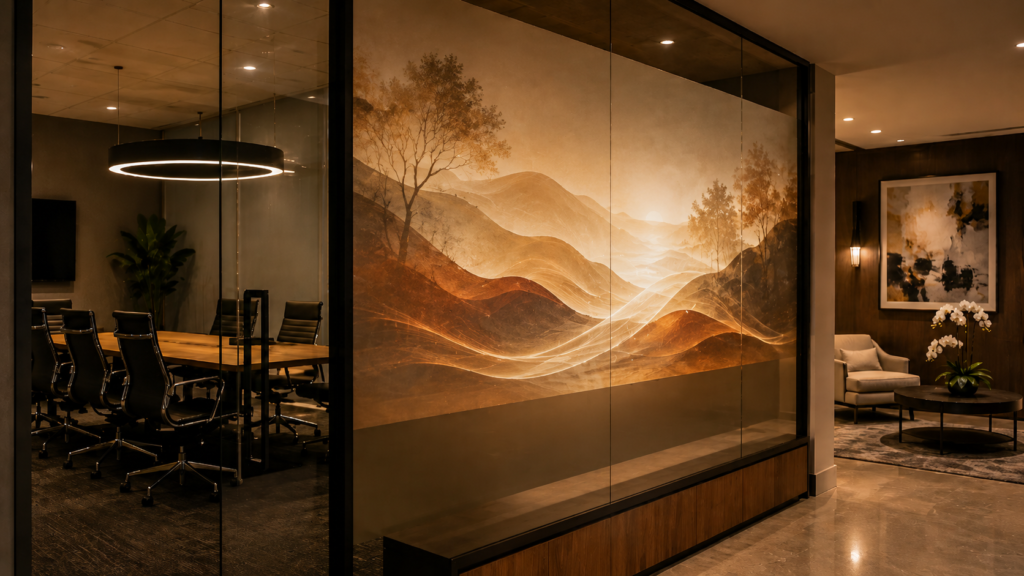
Rear projection film for privacy glass and partitions helps businesses turn ordinary interior glass into useful digital display space. Instead of using glass only as a divider, privacy surface, or architectural feature, companies can add projection film and create branded visuals, wayfinding, product content, meeting graphics, guest messaging, or atmospheric display effects.
For commercial buyers, this matters because many modern buildings already use glass everywhere. Offices use glass conference rooms. Hotels use glass walls and event partitions. Clinics use reception dividers. Restaurants use private dining glass. Showrooms use glass partitions to divide customer areas. Yet, much of that glass stays passive.
Rear projection film changes that. It allows a projector to display content from behind the glass so viewers can see the image from the front. As a result, a privacy partition can become a flexible digital communication surface.
This blog is written for RearProjectionFilms.com, with SSIDisplays.com as the product and project-support resource. It also references anti-glare support only when glare or reflection control becomes relevant.
Why Privacy Glass Creates a Strong Rear Projection Opportunity
Privacy glass and interior partitions already serve a design function. They separate spaces, create meeting zones, guide traffic, reduce visual openness, or add architectural style. However, many businesses can get more value from those same surfaces.
For example, a conference room glass wall can display a meeting welcome screen before a presentation. A hotel partition can show event visuals during a reception. A healthcare clinic can use a frosted-style glass area for calm patient education. Similarly, a restaurant can transform a private dining divider into a premium visual feature for events.
Because the glass already exists, rear projection film can improve the space without adding a bulky monitor. That makes it useful for design-focused environments where hardware should stay subtle.
What Is Rear Projection Film for Glass Partitions?
Rear projection film is a specialty film applied to glass, acrylic, or Plexiglas. A projector sits behind the surface and projects content onto the film. Viewers see the content from the opposite side.
In a partition application, the glass can serve two purposes. First, it can continue acting as a divider. Next, it can become a digital display surface when content plays.
Businesses can use rear projection film on:
- Glass conference room walls
- Office privacy partitions
- Hotel event dividers
- Restaurant private dining glass
- Healthcare reception partitions
- Spa and wellness dividers
- Showroom glass walls
- Retail fitting room glass areas
- Training room glass panels
- Museum exhibit dividers
- Trade show meeting room glass
- Lobby feature partitions
This flexibility makes rear projection film a strong fit for interiors that already rely on glass architecture.
Rear Projection Film vs. Standard Privacy Film
Standard privacy film and rear projection film serve different purposes. Privacy film usually blocks or diffuses visibility through glass. Rear projection film allows glass to display projected digital content.
However, the two concepts can overlap visually. Some rear projection films have a frosted or semi-opaque appearance, which can support privacy while also creating a display zone.
| Feature | Rear Projection Film | Standard Privacy Film |
|---|---|---|
| Primary Purpose | Displays projected digital content | Adds privacy or visual separation |
| Content Capability | Supports video, graphics, branding, and motion | Static appearance only |
| Best Use | Digital glass displays and branded partitions | Offices, bathrooms, meeting rooms, privacy zones |
| Flexibility | Content can update digitally | Appearance stays fixed |
| Visual Impact | Higher because it supports motion and light | Lower because it is static |
| Hardware Needed | Projector and media source | No projector required |
For many commercial spaces, rear projection film can provide more value when the glass needs to communicate, not just divide.
Best Uses for Rear Projection Film on Privacy Glass
Rear projection film works especially well when a divider needs to feel premium, useful, and flexible.
Conference Room Glass
Companies can use projection film on conference room glass to show meeting names, welcome visuals, internal announcements, brand videos, or agenda graphics.
During normal office hours, the glass can maintain a modern architectural look. During meetings or client visits, it can become a branded display.
Hotel and Event Partitions
Hotels can use rear projection film on event glass, ballroom entry partitions, and pre-function areas. Content can change for weddings, conferences, receptions, galas, or private events.
Because hotels often need fast content changes, digital projection gives event teams more flexibility than printed signs.
Restaurant Private Dining Rooms
Restaurants can use projection film on private dining glass to create custom event atmospheres. A corporate dinner might use subtle branded visuals. A rehearsal dinner may use soft ambient graphics. A product launch can use premium motion backgrounds.
As a result, the room feels more customized without permanent décor changes.
Healthcare Reception Areas
Clinics and healthcare facilities can use rear projection film on reception glass or waiting area dividers to show calm wellness visuals, wayfinding, service information, or patient education.
In this setting, content should stay simple, helpful, and easy to read.
Retail and Showroom Partitions
Retail stores and showrooms can use rear projection film on glass dividers to show product videos, seasonal visuals, launch content, or shopping prompts.
This can help guide customers through the space while reinforcing the brand experience.
Benefits of Turning Partitions Into Digital Displays
Rear projection film can add value to partitions in several practical ways.
Better Use of Existing Glass
First, it helps businesses use surfaces they already have. Instead of installing new display hardware, a company can transform a glass divider into a digital media surface.
Cleaner Interior Design
Next, the display can feel more integrated than a wall-mounted monitor. This matters in premium interiors where bulky hardware weakens the design.
Flexible Content Updates
A partition display can change by day, event, department, season, or campaign. Therefore, the same surface can support many communication needs over time.
Stronger Brand Experience
A branded glass display can make a space feel more modern and intentional. In client-facing areas, that can improve perception.
Event Revenue Potential
Hotels, restaurants, venues, and event spaces can use projection film as an upsell. Custom digital partition visuals can make private events feel more polished and valuable.
Choosing the Right Film for Partition Displays
The best rear projection film depends on lighting, transparency goals, content style, and viewer distance.
Definition Rear Projection Film
Definition Rear Projection Film is useful when businesses need clearer image contrast and strong commercial display performance. It can support office, showroom, healthcare, and lobby partition displays where readability matters.
Accent Rear Projection Film
Accent Rear Projection Film can work well when a frosted-style visual appearance fits the design. Because many privacy partitions already use frosted looks, Accent may blend naturally into commercial interiors.
Intrigue Rear Projection Film
Intrigue Rear Projection Film creates a more transparent, holographic-style display effect. This can work well for premium spaces, product launches, VIP rooms, technology showrooms, and experiential environments.
Sample Testing
Before choosing a final film, buyers should test samples on the actual glass. Lighting, glass tint, reflections, and projector brightness can change the final result.
Projector Placement for Glass Partitions
Projector placement is critical. Rear projection film needs a projector behind the viewing surface, so the available space behind the partition must be reviewed early.
Important projector questions include:
- Is there enough space behind the glass?
- Will the projector sit on the floor, ceiling, shelf, or hidden cabinet?
- Does the projector have the right throw distance?
- Can the projector stay aligned?
- Is there enough ventilation?
- Will guests or employees see the hardware?
- Can staff access it for maintenance?
- Will projector noise affect the room?
- Can cables stay hidden and safe?
In tight spaces, a short throw or ultra short throw projector may help. However, the projector, film, image size, and installation surface should be tested together.
Content Design for Partition Displays
Partition displays should usually look clean and intentional. Since partitions often sit in close-view environments, content should avoid clutter.
Strong content choices include:
- Slow abstract motion
- Simple welcome visuals
- Short event graphics
- Product-focused loops
- Wayfinding icons
- Soft atmospheric visuals
- Brand colors and motion
- Minimal text
- High-contrast imagery
- Clean animation
Avoid long paragraphs, busy backgrounds, fast flashing motion, and small text. The goal is to make the partition more useful without making the space feel noisy.
Privacy and Visibility Considerations
Rear projection film can affect how much people see through a glass partition. Some businesses want more privacy, while others want a transparent or floating display effect.
Before ordering, clarify the visual goal:
- Should the partition block visibility?
- Should it remain mostly transparent?
- Should content appear only when the projector is on?
- Should the film look frosted when off?
- Should people see through the glass from both sides?
- Should the display support privacy during meetings?
- Will the film cover the whole partition or only one zone?
These answers help determine the best film type and layout.
Glare and Reflection Planning
Interior glass can reflect lights, windows, screens, and polished floors. Because of that, glare should be reviewed before installation.
Helpful planning steps include:
- Test samples under real lighting
- Review overhead lights near the glass
- Check reflections from windows
- Adjust content contrast
- Avoid placing key visuals where glare appears
- Consider anti-glare support when needed
- Test viewing angles from both sides
Anti-glare film can support some rear projection projects when front-side reflections affect visibility. It should be treated as a supporting visibility tool, not a replacement for rear projection film.
Common Mistakes to Avoid
Covering Too Much Glass
A full-wall display may not always be necessary. Often, a focused display zone looks cleaner and costs less.
Ignoring the Room Behind the Glass
Rear projection needs space behind the surface. If that area is blocked or too shallow, the setup may need redesign.
Using Content That Feels Too Loud
Partitions often sit near people working, dining, waiting, or meeting. Therefore, content should support the environment rather than distract from it.
Forgetting Off-State Appearance
The film still has a look when the projector is off. Always review how the glass appears during non-display hours.
Skipping Sample Testing
Different films create different opacity, transparency, and brightness effects. Samples help buyers choose with confidence.
Rear Projection Film Partition Planning Checklist
| Planning Item | What to Confirm |
| Surface Type | Glass, acrylic, or Plexiglas |
| Display Zone | Full partition or selected area |
| Privacy Goal | Transparent, frosted, semi-private, or display-focused |
| Film Type | Definition, Accent, Intrigue, or sample-tested option |
| Projector Space | Enough depth behind the glass |
| Lighting | Reflections, daylight, and overhead lights reviewed |
| Content Style | Clean, simple, high-contrast visuals |
| Maintenance | Access for cleaning and projector service |
| Off-State Look | Film appearance when projector is off |
| Use Case | Branding, wayfinding, events, ambiance, or education |
This checklist helps buyers plan a cleaner, more reliable installation.
Future Trends in Digital Glass Partitions
Digital glass partitions will become more common as businesses look for flexible, multi-use interiors.
First, offices will use glass walls for both privacy and communication. Next, hotels and restaurants will offer more customizable private event environments. Additionally, healthcare and wellness spaces will use calming digital glass for patient communication and atmosphere.
Interactive partition displays may also grow. Touch, sensors, QR codes, RFID, NFC, and mobile triggers can turn glass dividers into active engagement points.
Over time, rear projection film will help businesses make interior glass more valuable without sacrificing modern design.
FAQ
Can rear projection film be used on privacy glass?
Yes. Rear projection film can be applied to suitable glass, acrylic, or Plexiglas surfaces. If the glass already has privacy treatment, the project should be tested first to confirm compatibility and appearance.
Does rear projection film make glass private?
Some film options can create a frosted or semi-opaque display zone, but rear projection film is primarily designed for projected visuals. Privacy goals should be reviewed before choosing the film.
Can a glass partition become a digital display?
Yes. Rear projection film can turn a glass partition into a digital display when paired with the right projector and content source.
Is rear projection film good for conference rooms?
Yes. It can support branded meeting visuals, welcome content, agenda displays, and privacy-enhancing digital surfaces.
Should I test samples first?
Yes. Sample testing helps compare opacity, brightness, transparency, contrast, and off-state appearance before a full installation.
Why Choose Screen Solutions International
Screen Solutions International helps businesses plan rear projection film displays that fit real commercial interiors. SSI offers rear projection films, film samples, anti-glare film, transparent displays, digital signage, LED video walls, high-bright displays, interactive kiosks, projector enclosures, and custom experiential display systems.
This matters because glass partition projects need more than film. They need the right surface, projector, content, lighting plan, visibility strategy, and maintenance access.
For rear projection education and ideas, visit RearProjectionFilms.com. To review product options and project support, visit SSIDisplays.com. For project help, call 888-631-5880.
Final Takeaway
Rear projection film for privacy glass and partitions helps businesses turn interior dividers into flexible digital display surfaces. Instead of using glass only for separation, companies can use it for branding, wayfinding, events, atmosphere, education, and customer engagement.
In summary, the best partition displays start with a clear goal. Buyers should choose the right film, test samples, plan projector placement, review lighting, and design content that fits the environment. With the right setup, privacy glass can become one of the most valuable visual surfaces in a commercial space.
To start planning a rear projection film partition display, visit RearProjectionFilms.com or call Screen Solutions International at 888-631-5880.
Sources
Internal SSI Links
- SSIDisplays.com
- Rear Projection Films
- Projection Film Options
- Rear Projection Film Samples
- Definition Rear Projection Film
- Accent Rear Projection Film
- Intrigue Rear Projection Film
- Anti-Glare Film
- Transparent OLED Displays