
Introduction
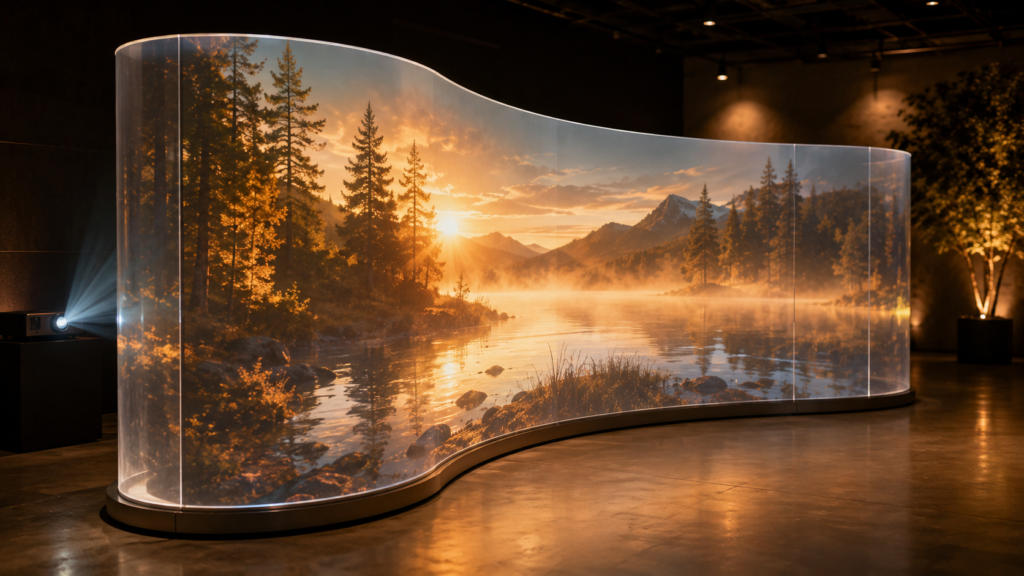
Rear projection film for curved glass and acrylic helps businesses create custom digital displays on non-standard surfaces. Instead of limiting a display to a flat wall, standard monitor, or rectangular screen, companies can explore projection film for curved partitions, acrylic panels, product displays, exhibit structures, architectural glass, and custom experiential environments.
For commercial buyers, this matters because many high-impact display projects are not built around flat screens. Museums use curved exhibit forms. Trade show booths use acrylic structures. Retail stores use sculptural display windows. Hotels and corporate spaces use curved glass walls. Meanwhile, branded environments often need displays that feel integrated, not attached as an afterthought.
Rear projection film can support these creative goals when the surface, film, projector, content, and installation approach are planned correctly. However, curved glass and acrylic projects need more careful review than basic flat glass installations. The curve can affect focus, image alignment, viewing angle, reflection, content layout, and film application.
RearProjectionFilms.com helps buyers understand how rear projection film works in real commercial spaces. Screen Solutions International supports these projects through SSIDisplays.com with rear projection films, film samples, anti-glare film, transparent displays, digital signage, LED video walls, projector enclosures, interactive kiosks, and custom display solutions.
If your project involves curved glass, acrylic, or a custom-shaped display surface, planning early can help prevent costly mistakes.
Why Curved Glass and Acrylic Displays Stand Out
Curved surfaces naturally attract attention. A curved glass wall, acrylic feature, or sculptural divider feels more premium than a standard flat panel. Because of that, curved display surfaces often work well in high-value environments where visual impact matters.
For example, a museum may use a curved acrylic panel to guide visitors through an exhibit. A retail brand may build a curved product display around a launch item. A corporate lobby may use curved glass to create a smooth architectural feature. Similarly, a trade show booth may use a curved acrylic wall to stand apart from standard booth structures.
Rear projection film can make those surfaces more useful. Instead of leaving the curve as a static architectural element, businesses can add motion, color, branding, educational content, or atmospheric visuals.
As a result, the surface becomes both a design feature and a communication tool.
Can Rear Projection Film Work on Curved Surfaces?
Rear projection film can work on some curved glass and acrylic surfaces, but the project should be evaluated carefully before ordering. Not every curve is the same. A gentle curve may be manageable, while a tight compound curve may create application or image distortion challenges.
The biggest factors include:
- Curve radius
- Surface material
- Film flexibility
- Panel size
- Image size
- Projector position
- Viewing angle
- Content type
- Installation method
- Lighting conditions
- Whether the curve is simple or compound
A simple curve bends in one direction. A compound curve bends in multiple directions, like a dome or bubble. In general, simple curves are easier to plan than complex curves.
Therefore, sample testing and project review are especially important.
Curved Glass vs. Curved Acrylic
Curved glass and curved acrylic can both support display projects, but they behave differently.
The difference is below.
Curved Glass
Curved glass often appears in premium architecture, lobbies, showrooms, and hospitality spaces. It can look polished and permanent. However, it may be harder to modify, replace, or test compared with acrylic.
Curved glass projects should review:
- Glass thickness
- Tint
- Coatings
- Reflection
- Surface cleanliness
- Curve radius
- Access for film application
- Installation safety
- Existing architectural constraints
Because curved glass may already be installed, buyers should test film samples on the actual surface whenever possible.
Curved Acrylic
Curved acrylic can be useful for trade shows, museums, product displays, retail fixtures, and custom exhibit builds. It is often easier to fabricate into custom forms than glass. However, acrylic can scratch more easily and may require careful cleaning.
Curved acrylic projects should review:
- Acrylic thickness
- Surface smoothness
- Scratch resistance
- Static and dust
- Mounting method
- Edge finish
- Curve consistency
- Transport needs
- Cleaning process
For temporary or portable displays, acrylic may offer more flexibility. Even so, the surface should be tested before a full build.
Best Applications for Curved Rear Projection Film Displays
Curved rear projection film displays can work well when the goal is to create a unique visual experience.
Museum and Exhibit Displays
Museums can use curved acrylic or glass panels to create immersive interpretive displays. A curved surface can guide visitors through a timeline, map, environment, or story.
Additionally, rear projection film can show animation, artifact context, diagrams, or atmospheric visuals. This helps the exhibit feel more dynamic without relying only on flat monitors.
Trade Show Booths
Trade show booths benefit from distinctive shapes. A curved acrylic projection wall can make a booth more noticeable from the aisle. It can also create a semi-private meeting area while showing brand visuals on the surface.
Because trade shows are competitive, curved projection displays can help create a memorable booth feature.
Retail Product Displays
Retail stores can use curved projection film surfaces for product launches, luxury showcases, cosmetics, technology demos, fashion displays, or seasonal campaigns.
A curved display can wrap around a product, frame a window, or create a sculptural brand moment. As a result, customers may be more likely to stop and look.
Corporate and Hospitality Interiors
Corporate lobbies, hotels, restaurants, and event spaces often use curved glass for design impact. Rear projection film can turn those surfaces into brand storytelling tools, wayfinding features, guest welcome displays, or atmospheric installations.
Because the display integrates into the architecture, it can look more refined than a standard screen.
Entertainment and Experiential Spaces
Entertainment venues, immersive rooms, brand activations, and themed environments can use curved projection film to create a more dimensional visual field. Content can wrap across the surface and create a stronger sense of movement.
This approach works especially well when the content is designed for the curve from the beginning.
Planning the Curve Radius
The curve radius affects both installation and image quality. A gentle curve may allow smoother film application and more predictable projection. A tighter curve may increase the risk of distortion, wrinkles, edge tension, or uneven focus.
Before planning the project, document:
- Total surface width
- Total surface height
- Curve radius
- Arc length
- Chord width
- Surface material
- Mounting method
- Viewing side
- Projector side
- Whether the curve is concave or convex
These details help determine whether rear projection film is practical for the surface.
For larger custom projects, it may be useful to create a small mockup first. A mockup allows buyers to test film behavior, content distortion, and projector placement before building the final display.
Projector Alignment for Curved Surfaces
Projector alignment becomes more complex on curved surfaces. A flat surface receives the image evenly. A curved surface changes the distance between the projector and different parts of the display.
This can affect:
- Focus
- Brightness uniformity
- Image shape
- Edge sharpness
- Content alignment
- Viewing angle
- Reflections
A projector may need careful placement to reduce distortion. In some cases, the content may need digital warping or mapping so it fits the curved surface properly.
Projection mapping software can help adjust the image to the curve. However, the more complex the surface, the more important testing becomes.
Content Design for Curved Projection Film
Curved display content should be designed specifically for the surface. Standard rectangular content may not look right when projected onto a curved panel.
Strong content choices include:
- Abstract motion graphics
- Environmental visuals
- Wide panoramic scenes
- Product silhouettes
- Flowing light patterns
- Large shapes
- Minimal text
- Animated textures
- Brand color fields
- Simple visual sequences
Avoid placing important text or logos near extreme curve edges. Those areas may distort more than the center. Also, avoid detailed UI layouts unless the display has been carefully mapped and tested.
For curved surfaces, content should feel spatial. It should use the curve as a feature, not fight against it.
Film Application Considerations
Applying film to a curved surface requires care. The installer must account for surface tension, alignment, dust, seams, and edge behavior.
Important installation questions include:
- Can the film be applied smoothly to the curve?
- Will the film need seams?
- Where should seams be placed?
- Is the curve gentle enough for the selected film?
- Can installers access the entire surface?
- Will edge lifting be a concern?
- Does the surface need special cleaning first?
- Should the display use smaller sections instead of one large sheet?
- Is the display permanent or temporary?
For complex shapes, professional installation is strongly recommended. A small mistake on a curved surface can be more visible than on a flat panel.
Sample Testing for Curved Displays
Sample testing is essential for curved glass and acrylic projects. A sample can show how the film behaves on the real surface and whether the projected image looks acceptable.
When testing, evaluate:
- Film adhesion
- Opacity
- Transparency
- Wrinkling
- Edge behavior
- Brightness
- Focus
- Image distortion
- Viewing angle
- Reflection
- Content readability
- Appearance when projector is off
If possible, test at the same curve radius as the final display. A flat sample test may not reveal problems that appear on a curved surface.
Rear Projection Film Options for Custom Displays
Different film options can create different effects on curved glass or acrylic.
Definition Rear Projection Film
Definition Rear Projection Film can support sharper commercial visuals when clarity and contrast matter. It may be useful for curved displays that need strong image performance.
Accent Rear Projection Film
Accent Rear Projection Film can support bright imagery in controlled environments. Its frosted-style appearance may work well on curved privacy surfaces, partitions, or interior displays.
Intrigue Rear Projection Film
Intrigue Rear Projection Film can create a more transparent, floating-image effect. For curved acrylic, product launches, exhibits, or futuristic displays, this can create a strong visual impression.
Anti-Glare Support
Some curved surfaces reflect light from multiple angles. Anti-glare support may help in certain projects, although it should be tested carefully with the chosen film and surface.
Common Mistakes With Curved Rear Projection Displays
Treating a Curved Surface Like a Flat Screen
Curved surfaces need different projector planning, content design, and installation review.
Ignoring Image Distortion
Curves can stretch or bend visuals. Test content before final approval.
Using Too Much Text
Text is harder to manage on curved surfaces. Keep copy short and place it in the least distorted viewing area.
Skipping a Mockup
A mockup can reveal issues before the final surface is built. This is especially useful for custom acrylic displays.
Forgetting Maintenance Access
Curved displays still need cleaning, projector access, and content updates.
Choosing the Film Before Understanding the Surface
Film selection should happen after reviewing material, curve radius, lighting, and visual goals.
Curved Rear Projection Film Planning Checklist
| Planning Item | What to Confirm |
|---|---|
| Surface Material | Curved glass, acrylic, or Plexiglas |
| Curve Type | Simple curve or compound curve |
| Radius | Gentle, moderate, or tight curve |
| Film Choice | Definition, Accent, Intrigue, or tested option |
| Projector Position | Distance, angle, and available space |
| Content | Designed for curved projection |
| Mapping | Need for digital warping or projection mapping |
| Samples | Tested on matching curve when possible |
| Lighting | Reflections and ambient light reviewed |
| Installation | Access, seams, edge behavior, and cleaning |
| Maintenance | Projector and surface care planned |
This checklist helps buyers start the project with the right technical questions.
Future Trends in Curved Projection Film Displays
Curved projection film displays will become more common as brands look for more immersive and architectural display formats.
First, museums and visitor centers will use more curved media surfaces to create layered storytelling. Next, retail brands will use sculptural acrylic displays to create launch moments that feel more premium than standard signage. Additionally, trade show booths will use curved projection walls to create more memorable brand environments.
Meanwhile, projection mapping tools will make curved content easier to align. Better projectors, improved content workflows, and stronger film options will also help businesses create more reliable custom displays.
Over time, rear projection film will help more companies turn curved glass and acrylic into digital experiences.
FAQ
Can rear projection film be applied to curved glass?
Rear projection film may work on some curved glass surfaces, but the project should be reviewed carefully. Curve radius, film type, projector position, and installation method all matter.
Can rear projection film be used on curved acrylic?
Yes, curved acrylic can be a strong option for custom displays, exhibits, trade shows, and product showcases. Sample testing is recommended before full installation.
Does curved projection film need special content?
Often, yes. Curved surfaces may distort standard rectangular content, so visuals should be designed or mapped for the curve.
Is a curved rear projection display harder to install?
Usually, yes. Curved surfaces require more planning than flat glass because film application, alignment, seams, and projector focus become more complex.
Should I test samples first?
Yes. Sample testing is especially important for curved glass or acrylic because the curve can affect film appearance, projection quality, and viewing angle.
Why Choose Screen Solutions International
Screen Solutions International helps businesses plan rear projection film projects for real commercial environments, including custom glass and acrylic display concepts. SSI offers rear projection films, film samples, anti-glare film, transparent displays, digital signage, LED video walls, high-bright displays, interactive kiosks, projector enclosures, and custom experiential display systems.
This matters because curved displays require more than a film order. They need surface review, projector planning, content strategy, sample testing, and installation support.
For rear projection education and ideas, visit RearProjectionFilms.com. To review product options and project support, visit SSIDisplays.com. For project help, call 888-631-5880.
Final Takeaway
Rear projection film for curved glass and acrylic can help businesses create more unique and memorable commercial displays. Curved surfaces add visual interest, while projection film adds motion, content, and communication value.
In summary, curved rear projection film projects need careful planning. Buyers should review the surface material, curve radius, film type, projector placement, lighting, sample testing, and content design before moving forward. With the right approach, curved glass and acrylic can become powerful digital display surfaces.
To start planning a custom rear projection film project, visit RearProjectionFilms.com or call Screen Solutions International at 888-631-5880.
Sources
Internal SSI Links
- SSIDisplays.com
- Rear Projection Films
- Projection Film Options
- Rear Projection Film Samples
- Definition Rear Projection Film
- Accent Rear Projection Film
- Intrigue Rear Projection Film
- Anti-Glare Film
- Transparent OLED Displays